The Appalachian Trail for Motorcycles: My Introduction to Motocamping
Intro: Roads With No Roads
At first glance, a motorcycle road trip seems like a strange fit for Maps With No Roads.
The Blue Ridge Parkway literally has the word “parkway” in the title. The scenic paved path was created by the federal government. There are visitor centers. Gift shops. Speed limits. Tourists in Subarus pulling into overlooks every few miles to photograph mountains that look suspiciously similar to the mountains from the previous overlook.
Not exactly the High Peaks Wilderness or the Wadi Rum desert.
But I’m beginning to realize that adventure is less about geography and more about stepping into the unknown, and the moments where nothing goes according to plan. And as it turns out, motocamping is exceptionally good at creating that feeling.
In many ways, motocamping feels like backpacking’s louder, faster cousin. Your entire life still fits into a small collection of bags strapped to your machine. You spend your days exposed to the weather. You travel from one temporary home to another. You wake with the sun, smell like smoke and sweat and camp coffee, and slowly become disconnected from the normal rhythms of modern life.
The biggest difference is scale.
Bill Bryson once wrote in A Walk in the Woods:
“Distance changes utterly when you take the world on foot. A mile becomes a long way, two miles literally considerable, ten miles whopping, fifty miles at the very limits of conception…”
Backpacking shrinks the world into intimate detail. A single mountain can consume an entire day. You notice every root, every stream crossing, every change in elevation.
A motorcycle does the opposite. It expands the world. In a single day, you can watch winter become spring.
You can leave bare gray forests in Virginia and ride into blooming valleys in North Carolina. You can feel the air cool twenty degrees as you climb a mountain pass, then warm again as you descend into farmland. On a motorcycle, you aren’t sealed away from the environment like you are in a car. The smells and temperatures of the world become your own.
At thirty miles per hour and up, smells become a kind of symphony. Wet earth. Pine needles. Woodsmoke. Fresh-cut grass. The petrichor smell of rain arriving before you see the clouds that carry it.
It is difficult to explain to people who have never traveled this way. And maybe that’s part of the appeal.
But on the other hand, the rest of the quote feels very much like both motocamping and backpacking,
“Life takes on a neat simplicity, too. Time ceases to have any meaning. When it is dark, you go to bed, and when it is light again you get up, and everything in between is just in between. It’s quite wonderful, really.
You have no engagements, commitments, obligations, or duties; no special ambitions and only the smallest, least complicated of wants; you exist in a tranquil tedium, serenely beyond the reach of exasperation, “far removed from the seats of strife,” as the early explorer and botanist William Bartram put it. All that is required of you is a willingness to trudge.”
There is also the simple fact that my knees are no longer twenty years old.
Years of hiking, military wear-and-tear, and the general physical consequences of Marine Corps warfighting have introduced a very rude concept into my life called “consequences.” Backpacking still calls to me, and always will, but motocamping feels like a natural evolution of the same itch. It offers the same minimalism, solitude, and immersion into the outdoors while allowing me to cover landscapes on a scale that would take weeks on foot.
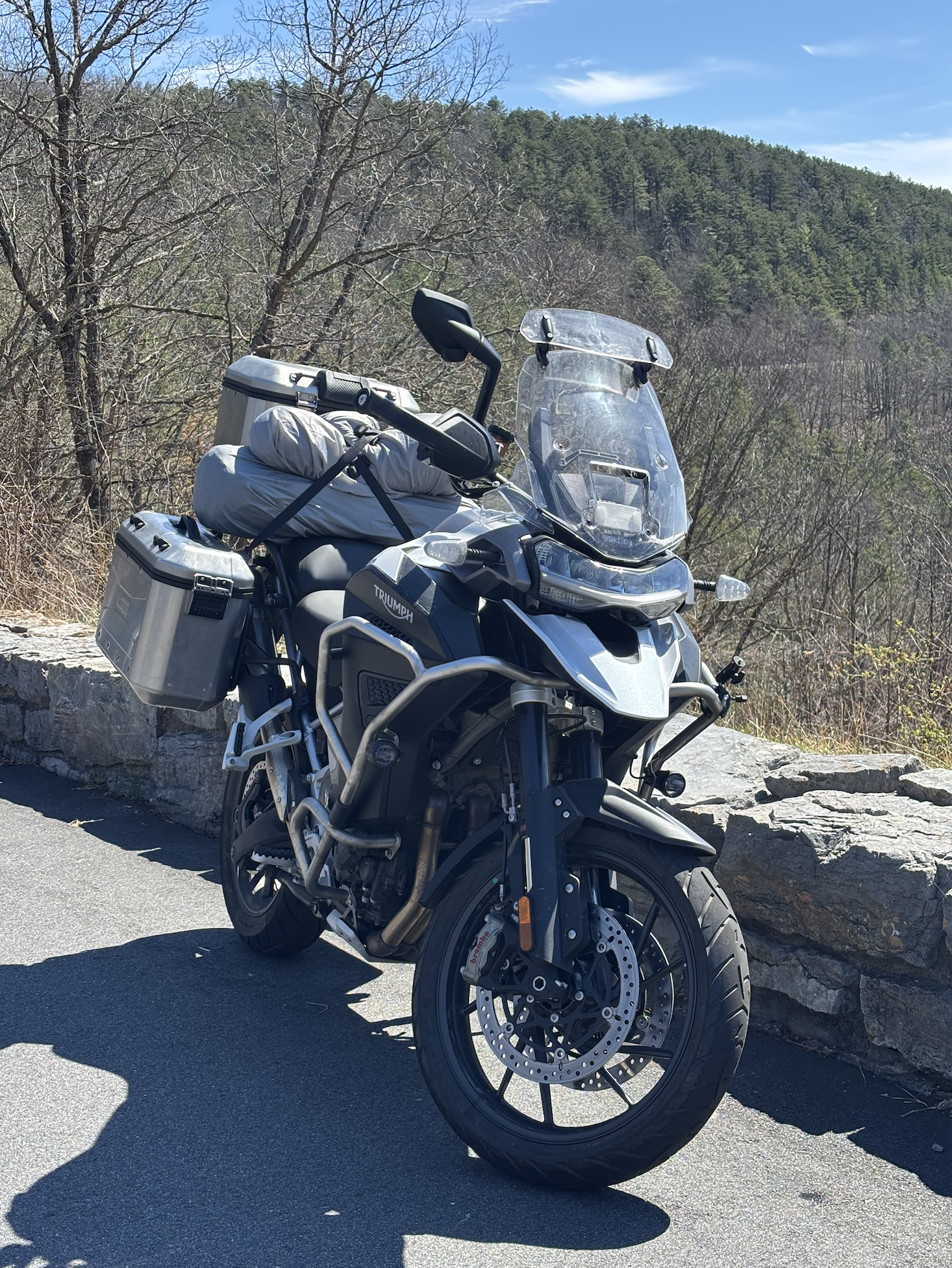
The inspiration for this trip came partly from watching Ewan McGregor and Charley Boorman’s The Long Way Round, which I day dreamt about over the winter while staring at my new-to me Triumph Tiger 1200 GT Explorer sitting in the garage like an expensive, overly complicated promise.
Compared to my Bonneville, this bike is a beast. Massive in weight, size, and displacement, she quickly earned the nickname Buffy.
Partly because her size and shape reminded me of a Buffalo. Partly because, like many millennials, I had a teenage crush on Sarah Michelle Gellar. Mostly because both explanations amused me equally.
So as she sat in the garage through winter I began planning my next adventure. The Blue Ridge Parkway felt like the perfect proving ground for learning motocamping properly.
The parkway itself was born during the Great Depression, stitched together through the labor of the Civilian Conservation Corps as part scenic road, part economic lifeline for struggling Appalachian communities. It runs nearly 500 miles from Shenandoah National Park in Virginia to the Great Smoky Mountains in North Carolina and Tennessee, deliberately avoiding commercial development wherever possible. No billboards. No truck traffic. No urban sprawl. The way in winds through the mountains for hundred and hundreds of miles, I like to think of it as the Appalachian Trail for motocamping.
Or at least, that was the theory.
Because almost immediately, absolutely nothing went according to plan.
Day 1: Southbound
I was supposed to leave Monday.
Instead, after studying weather forecasts like a medieval peasant attempting to interpret divine signs from cloud formations, I abruptly departed Sunday morning to avoid an incoming thunder storm in the Smokies later that week.
This seemed wise at the time.
What I failed to account for was the fact that “early April” in the Appalachian Mountains is essentially a diplomatic compromise between winter and spring in which neither side fully agrees to cease hostilities.
The entire ride from New Jersey to Front Royal, Virginia hovered in the mid-40s. At highway speeds, that kind of cold works its way through riding gear with slow determination. My new REV’IT! Sand 5 H2O suit performed admirably, but after several hours, even good gear begins to lose negotiations with physics.
Still, Buffy devoured highway miles effortlessly. The Tiger 1200 was built for this kind of work. The big 12,000 cc inline 3-cylinder engine hummed steadily beneath me while New Jersey suburbs gave way to Maryland highways and eventually the rolling folds of Virginia farmland.
The ride itself was fairly boring. Interstate travel rarely feels adventurous. Highways exist to erase landscapes, and make them all blur together. But there was still something satisfying about the simple act of leaving.
No grading. No meetings. No notifications demanding immediate attention.
Just movement.
By evening, I rolled into a cheap motel outside the north entrance of Shenandoah National Park. The room smelled faintly of cigarettes and industrial cleaning products. The kind of motel where you briefly inspect the sheets like a forensic investigator before committing to sleep.
Luxury.
Day 2: Skyline Drive
Morning arrived below freezing.
I lingered in the motel room longer than planned, sipping aggressively mediocre coffee while doing Sudoku and waiting for road temperatures to rise above “potentially catastrophic.”
The coffee was truly terrible. Motel coffee exists in a strange category somewhere between beverage and punishment.
Eventually, I layered up and stopped at a local diner for eggs and real coffee before entering Shenandoah.
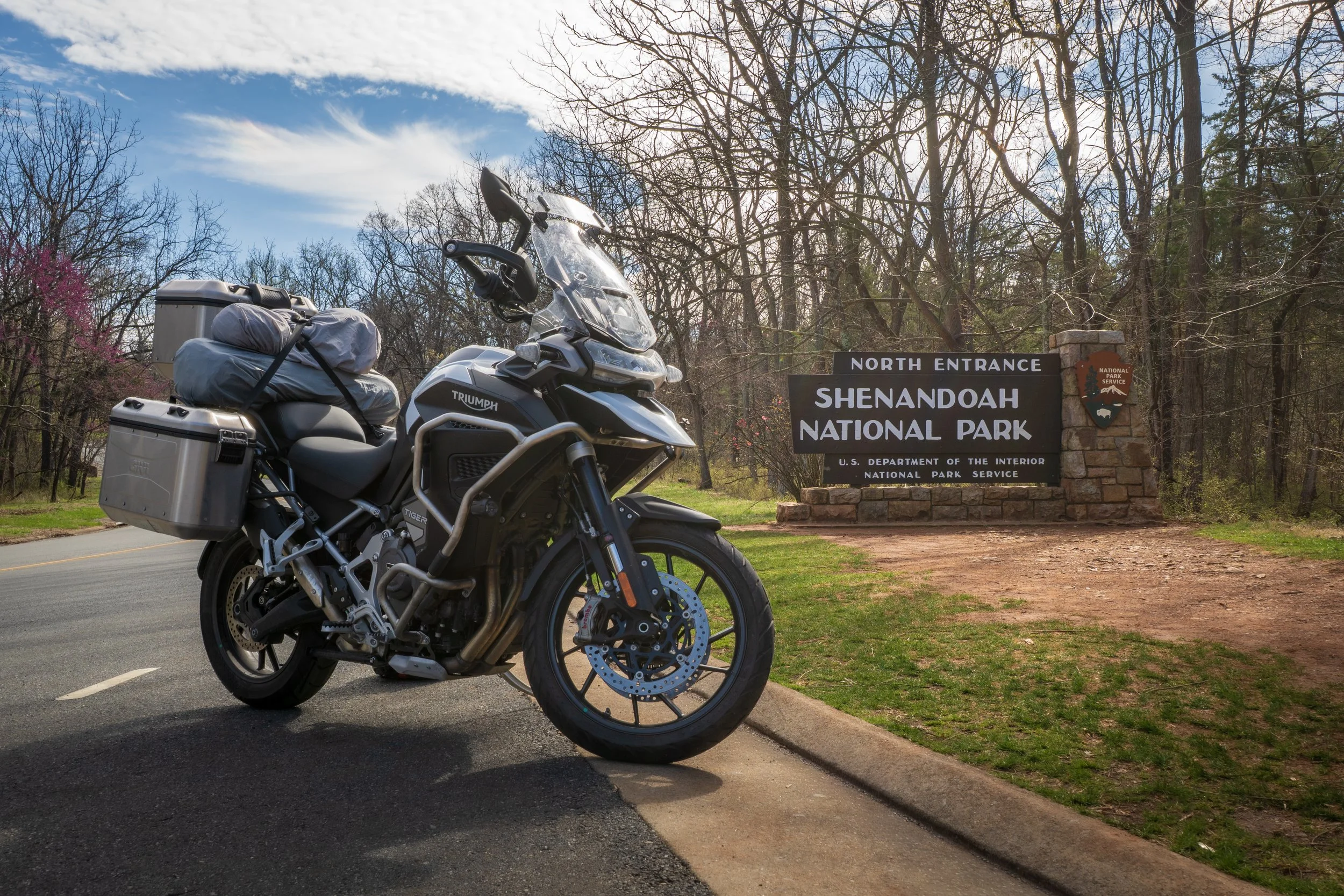
Skyline Drive immediately felt different from the interstate. Slower, quieter, peaceful.
The Appalachian Mountains are ancient beyond comprehension. Long before the Rockies thrust upward in jagged violence, these mountains were already old. Time and erosion have worn them into softer shapes, but there is something deeply calming about them. They don’t overwhelm you with scale the way western mountains do. They invite you to meander through their rolling hills instead.
Not long after leaving the Big Meadows area, I came upon two other motorcyclists. Without ever exchanging names or words, we found ourselves riding together for several dozen miles through the curves.
There is a strange fellowship among motorcyclists that reminds me a little of backpackers on long trails. Complete strangers become temporary companions simply because you are all participating in the same small absurdity.
Eventually they peeled off at an overlook.
An hour later, while I rested at another viewpoint, they passed again and waved.
That was the entirety of our relationship.
It somehow felt meaningful anyway.
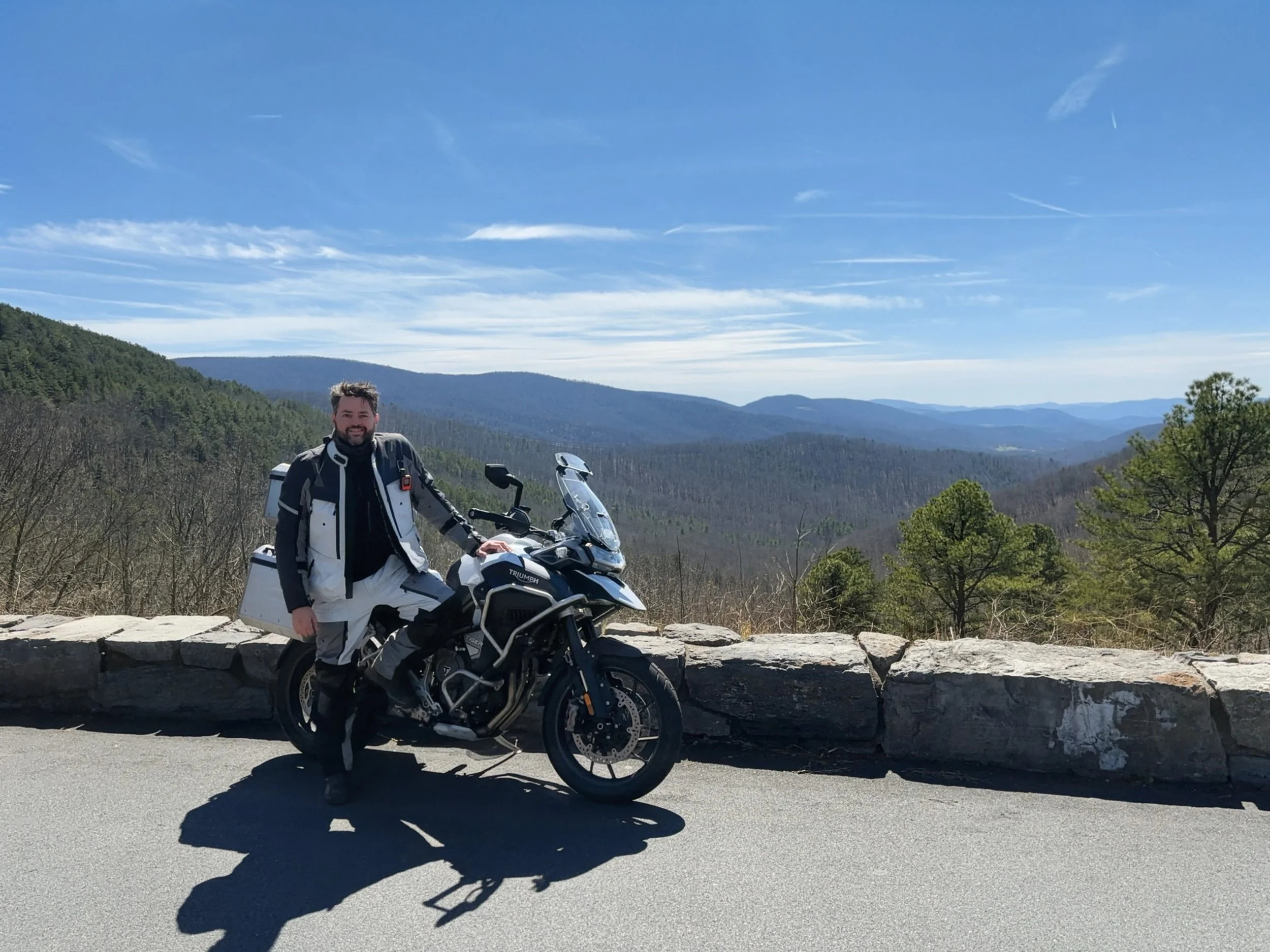
Further south, signs of spring finally began appearing. Bright green buds emerged against gray forests. Pink blossoms appeared in valleys below ridgelines still trapped in winter. Appalachia was slowly waking up.
Then I dropped the bike.
Not while riding, thankfully.
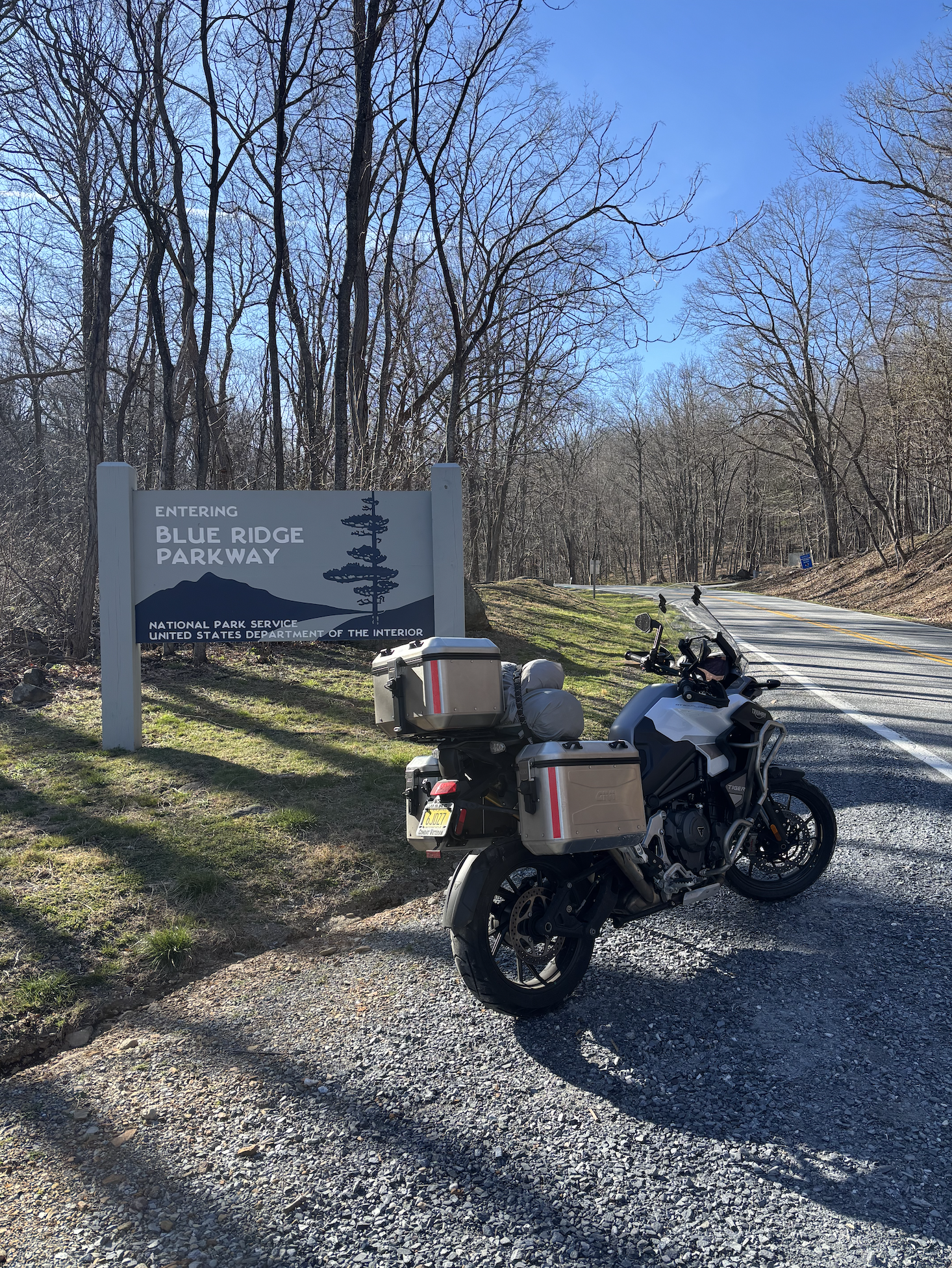
I had stopped to take a photo beside a Blue Ridge Parkway sign, maneuvered onto loose gravel on an incline, and suddenly found myself watching six hundred-plus pounds of motorcycle begin falling in slow motion toward the Earth.
There is a very specific emotional experience that occurs during the exact half-second when you realize a motorcycle is going over and there is absolutely nothing you can do to stop it.
It is mostly profanity.
Fortunately, Buffy was built for rough treatment. Crash bars hit first. I rolled clear onto the gravel with only wounded pride. Truthfully, I had anticipated this moment for months. Before buying the bike, I had already researched and practiced proper lifting techniques because every experienced ADV rider says the same thing: You are going to drop it eventually.
Might as well get the first one over with.
By evening, another problem emerged.
Every campground I planned to use was closed for the season.
Apparently, early April sits in an awkward limbo where spring technically exists, but tourism infrastructure remains unconvinced.
I drove around searching for stealth camping options before sunset but found nothing that felt safe or legal enough to avoid becoming the subject of a local news article.
Eventually I ended up in the sleepy mountain town of Bedford, Virginia, eating dinner at the only restaurant still open on a Sunday night while searching motel listings on weak WiFi.
“Improvise, adapt, overcome,” I muttered to myself.
The motel was terrible.
I missed the woods immediately.
That night, while lying in bed listening to distant highway traffic, I researched dispersed primitive campsites in Pisgah National Forest and found what looked like an epic campsite overlooking a cliff Linville Gorge.
Hope returned.
Day 3: The Ghost Parkway
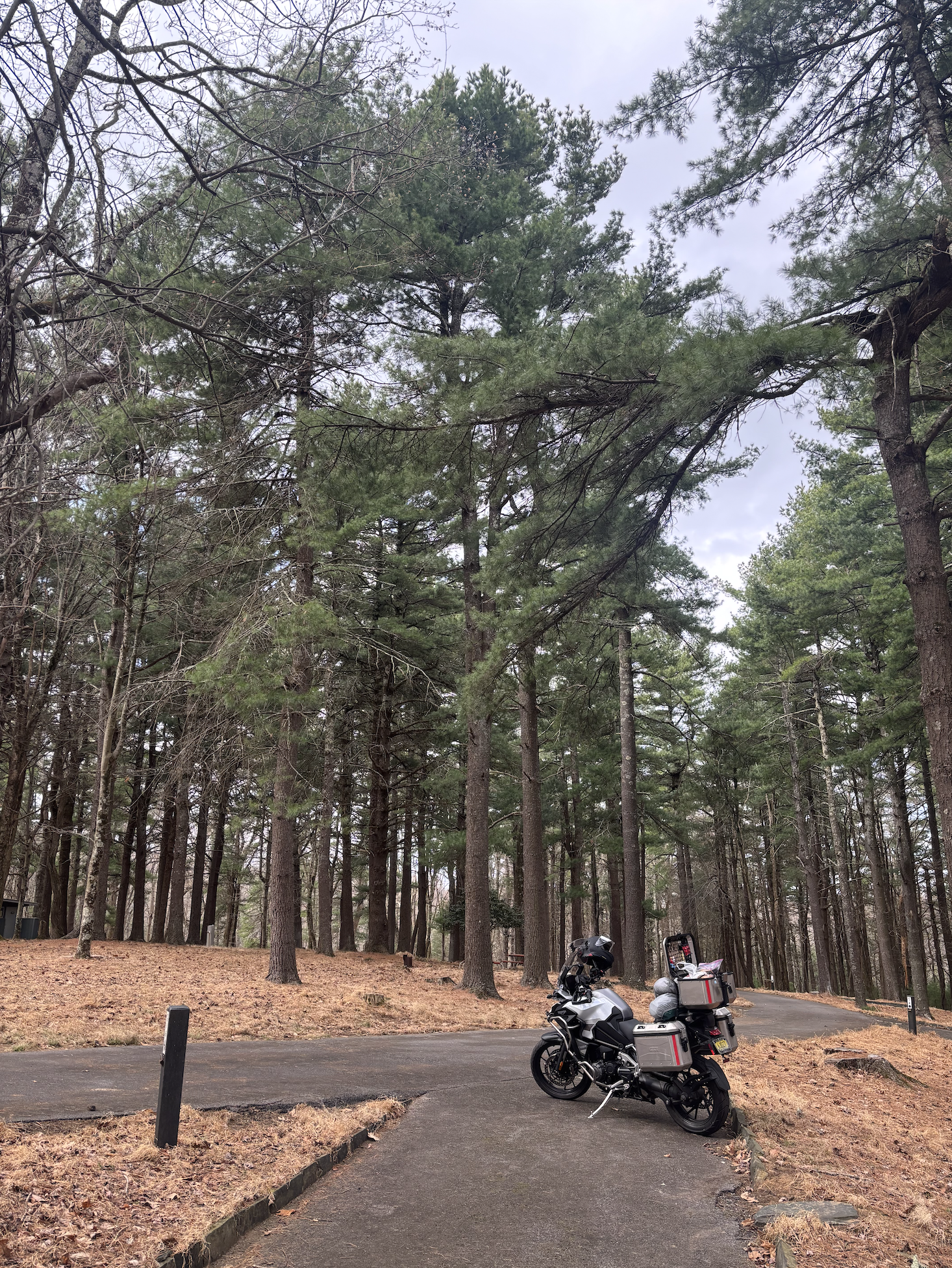
Southern Virginia and northern North Carolina felt almost abandoned.
Entire stretches of the parkway were empty except for occasional deer and the endless tunnels of bare hardwood forests. Campgrounds sat vacant behind locked gates. Visitor centers were shuttered. The road occasionally disappeared entirely due to seasonal closures, forcing me back through the ugly gravitational pull of civilization.
Stroads. America’s greatest architectural crime.
One moment I would be gliding through silent mountains. The next I’d forced off the parkway and be trapped beside gas stations, chain restaurants, and six-lane commercial purgatory before finally escaping back into the hills.
Still, there was beauty everywhere.
At higher elevations, the forests remained skeletal and gray except for stubborn rhododendrons clinging to winter. Lower valleys hinted at spring. Farmland rolled across distant hillsides. Morning fog pooled in hollows like spilled almond milk.
By afternoon, I finally reached Linville Gorge Wilderness.
The road into camp immediately became more interesting.
Loose dirt. Ruts. Uneven climbs.
Nothing extreme by actual off-road standards, but for a first-time ADV rider on a gigantic fully loaded motorcycle, it felt appropriately intimidating.
Buffy handled it beautifully.
I did not.
At least not initially.
Adventure motorcycles occupy a strange category of machine. They are simultaneously incredibly capable and alarmingly heavy. Riding one off pavement feels a little like teaching a buffalo ballet.
Still, something slowly clicked.
The further I rode, the more relaxed I became.
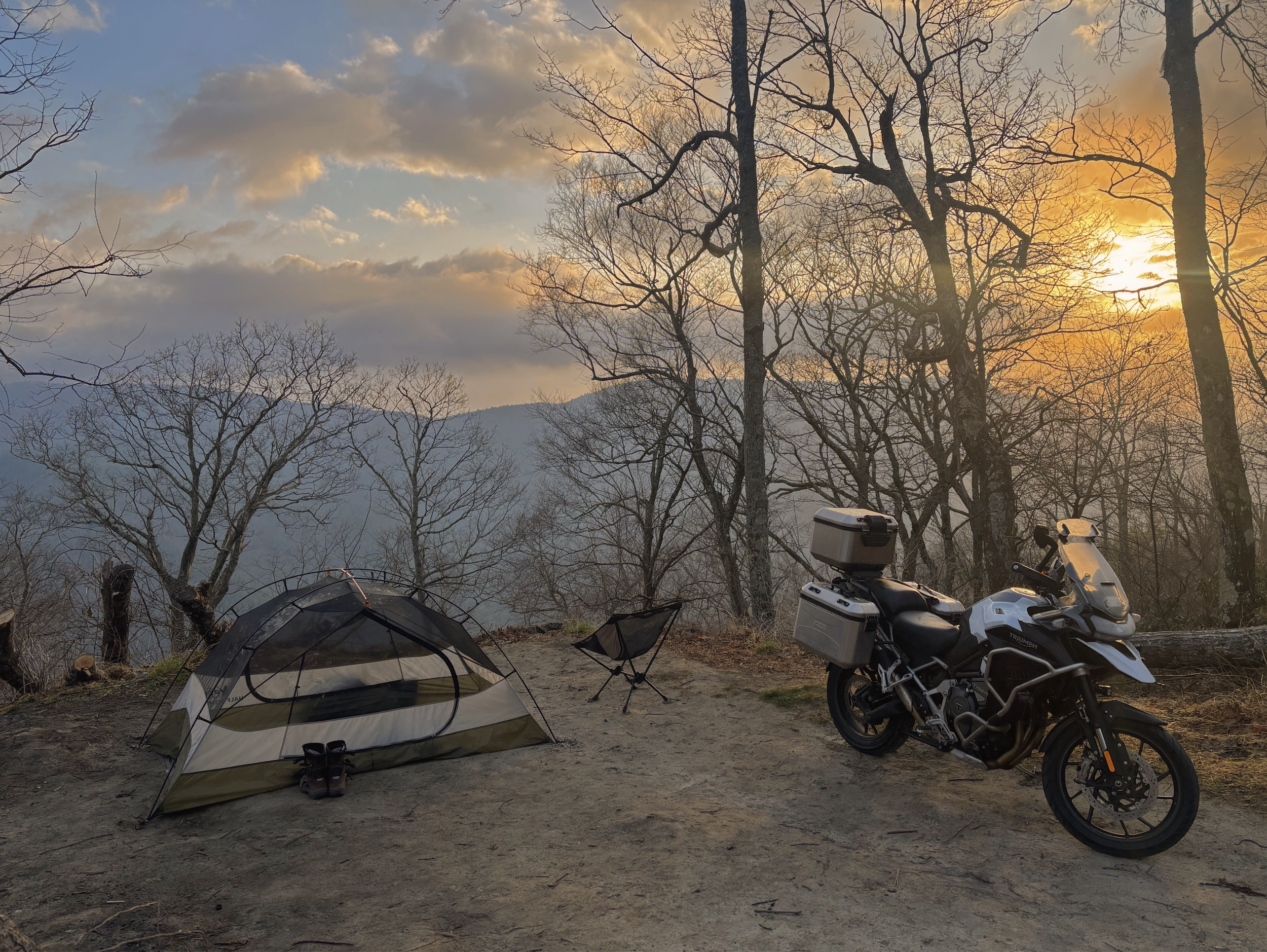
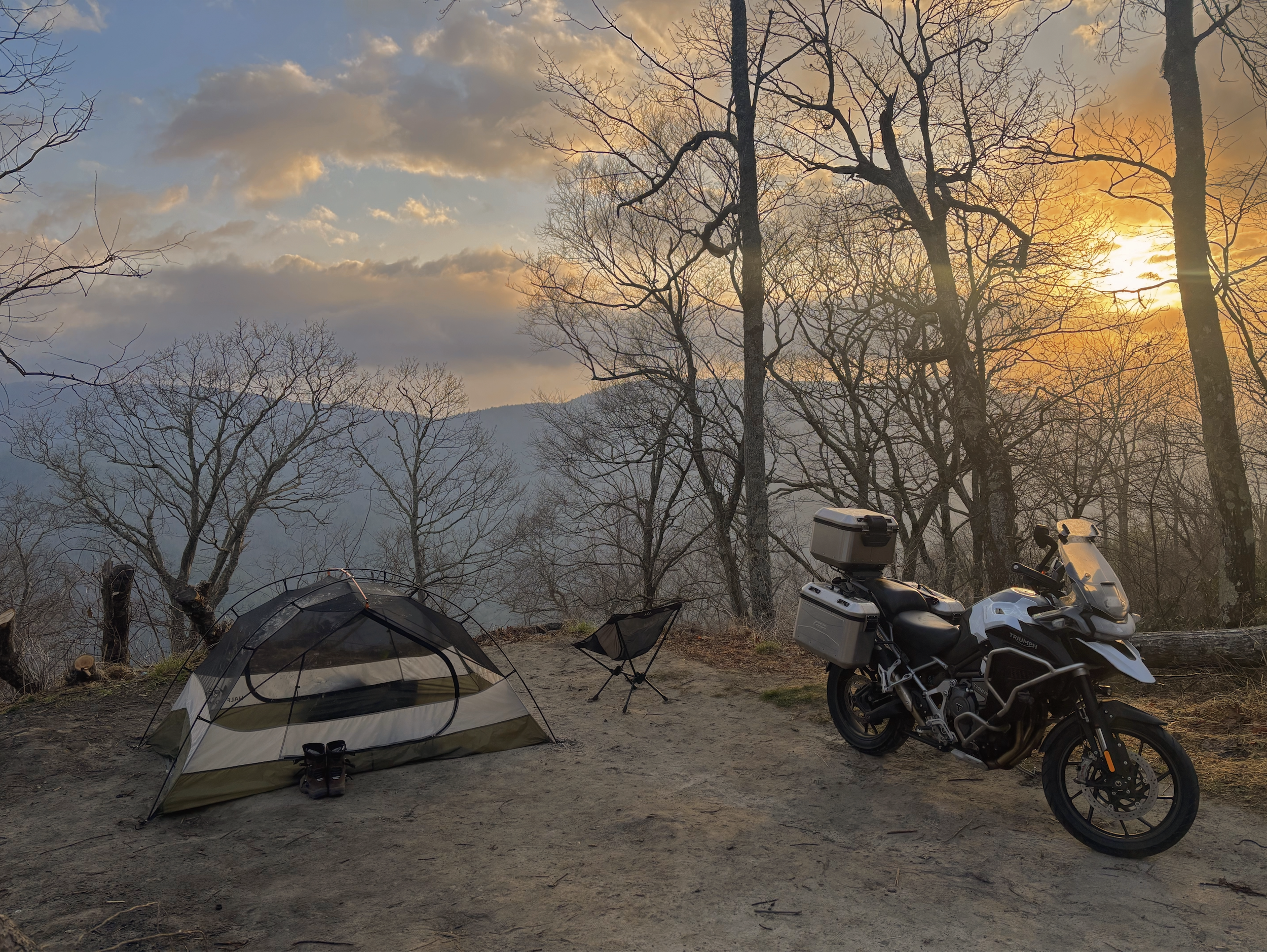
By sunset, I arrived at an absolutely ridiculous dispersed campsite overlooking Linville Gorge.
Silent forest. Cold mountain air. An enormous Appalachian sunset pouring gold across endless ridgelines.
I set up my REI Half Dome tent, cooked dinner beside the overlook, and sat watching darkness settle over the mountains.
“What a fuck’n life, eh?”
It slipped out aloud to nobody.
Later that evening, Ariana called.
Cell service on my solo trips is usually nonexistent, which means communication often depends on my satellite InReach Mini messenger. During my Jordan desert crossing, holed up in a canyon, I once lost connection, missed a check-in message entirely and accidentally convinced her I had possibly died somewhere in Wadi Rum.
Thankfully, Appalachia was less dramatic.
Still, after the call ended, I found myself conflicted. Part of me loved hearing her voice in this isolated wilderness. However, seeing cell service and being tempted to doom scroll, another part of me wanted to throw the phone into the gorge below.
The entire point of these trips is disconnection. Simplicity. Temporary escape from the constant digital static of modern life.
Eventually I shut the phone off and watched the last light disappear beyond the mountains.
Silence returned. And it felt wonderful.
Day 4: A Teacher in the Smokies
I woke before sunrise.
The mountains glowed blue-gray beneath slowly brightening clouds while coffee steamed from my camp stove. The forest remained almost perfectly silent except for distant birdsong and the faint hiss of boiling water.
It struck me how similar this felt to backpacking.
You carry your entire existence with you. Your needs become beautifully uncomplicated. Shelter. Warmth. Food. Movement.
Everything else falls away.
The ride south continued through North Carolina, interrupted occasionally by seasonal road closures and increasingly frequent fuel stops. As saddle fatigue accumulated, my rest breaks became shorter and more necessary. Early in the trip I could comfortably ride two hours before stopping. By now, an hour felt about right.
I stopped at Cherry Cove view point to hydrate and snack. A family of 4 stopped by the view point. Husband and wife about my age, maybe a bit older. Two kids, 9-10ish. They were taking pictures, so I offered to take a picture of all of them. They seemed very friendly and appreciative. They were headed all the way to the smokies too.
As I rode off, the little girl waved. I beeped the horn goodbye.
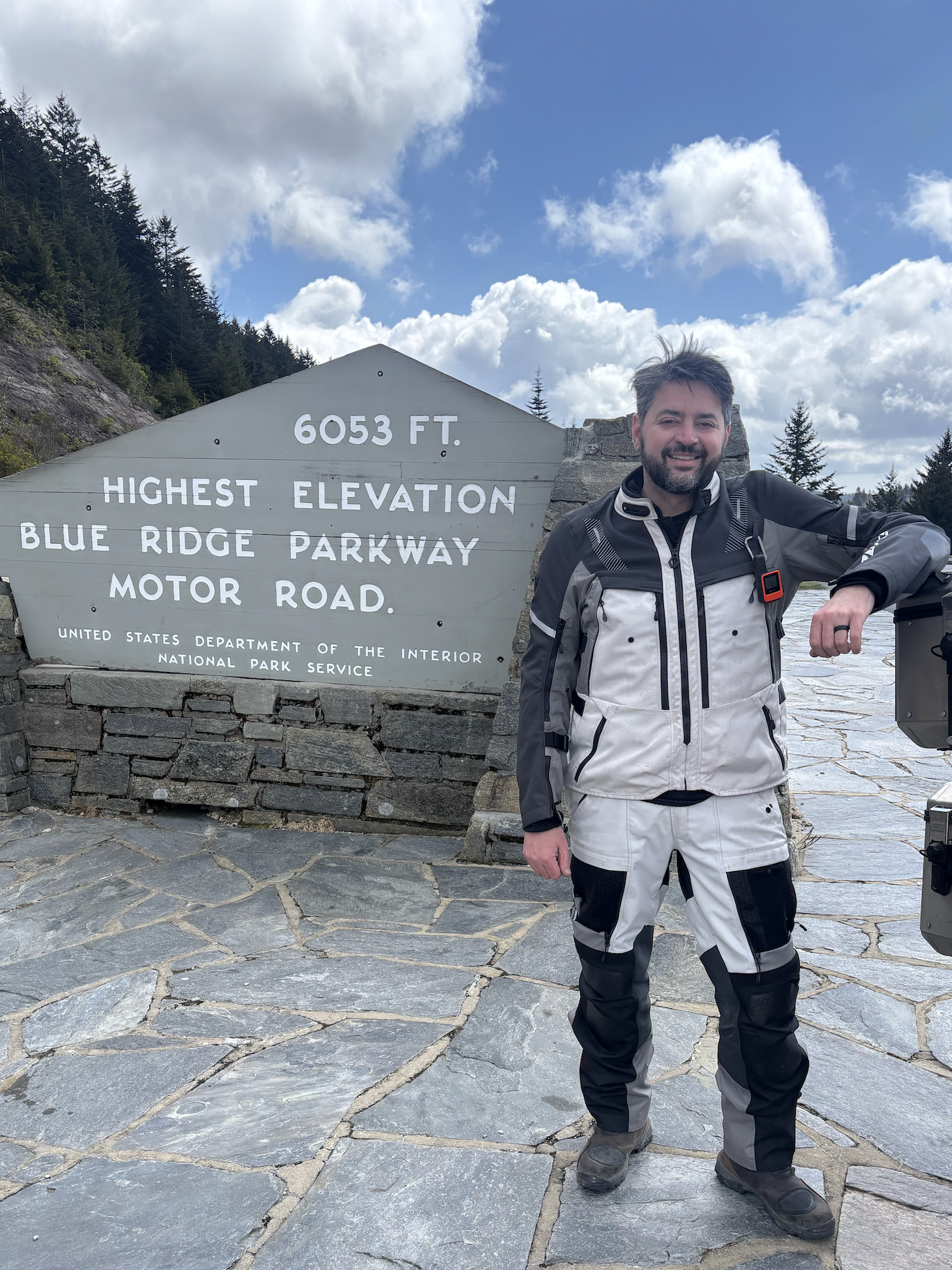
An hour later, I stopped at the highest point on the Blue Ridge Parkway, and we encountered each other again. Their daughter recognized the motorcycle immediately and ran over excitedly.
A little less shy this time and fascinated by the big ADV bike. Her father had recently bought his first motorcycle and she excitedly told me all about it while she asked endless questions about Buffy, to which I was happy to answer.
Her mother looked genuinely surprised and almost apologetic.
It occurred to me then that I probably looked like every intimidating biker stereotype imaginable. ADV armor. Giant motorcycle. Bearded guy alone in the mountains.
And yet, despite my best efforts, the teacher identity followed me anyway.
Somewhere beneath the motorcycle gear and helmet was still Mr. Porcelli from room B2214, instinctively encouraging curiosity in kids.
Honestly, I liked that realization.
After a couple of minutes, the kid paused, and then sheepishly asked if she could try to sit on the motorcycle.
Both parents looked shocked at the boldness, but I said absolutely.
They helped her up, and explained what all the controls did, and her dad took lots of pictures. That kid is going to be the star at ‘show-and-tell’ next week.
The Great Smoky Mountains arrived almost without announcement.
No dramatic gates. No entrance booths. No long tourist lines.
Just mountains rolling endlessly into blue haze.
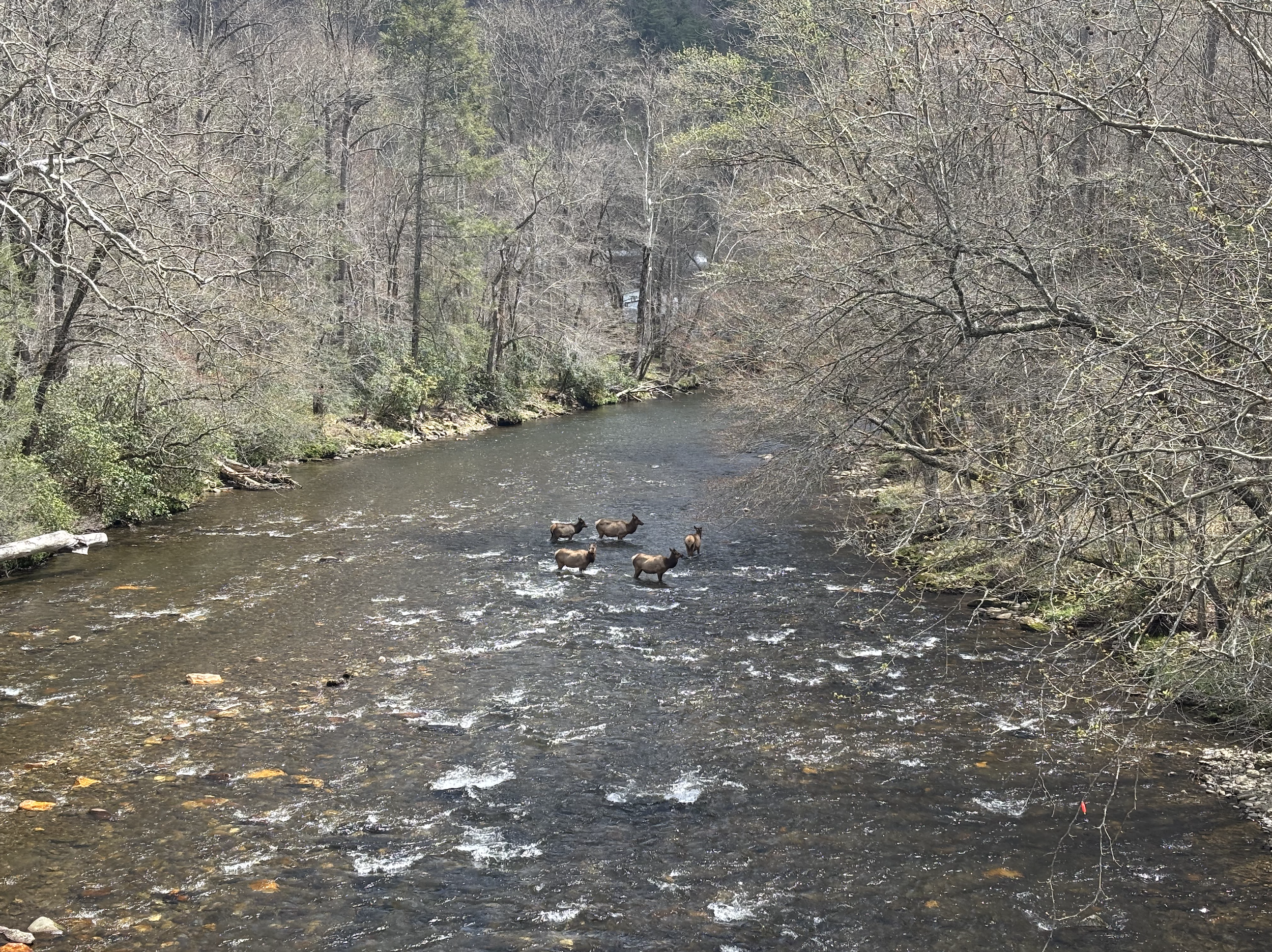
Then elk. So many elk.
The visitor center, however, was absolute chaos. Packed parking lots. Tourists everywhere. After days of near-empty roads, civilization hit like sensory overload.
Finding campsites proved equally disastrous.
Apparently only two campgrounds were open this early in the season, and both were fully booked.
Naturally.
I sat beside the river eating an Italian hero while trying to determine my next move.
At some point I spilled Italian dressing all over my riding pants.
This immediately introduced a new concern: Would I now smell delicious to bears?
Probably not.
But also maybe yes.
I rode into town and located a surprisingly nice riverside motel with a balcony view of the river. I spent several minutes in the bathroom scrubbing Italian dressing out of expensive motorcycle gear using motel soap like some deranged Appalachian laundromat.
Day 6: Tail of The Dragon, Thunderstorms, and Hostels
The next morning I climbed toward Newfound Gap.
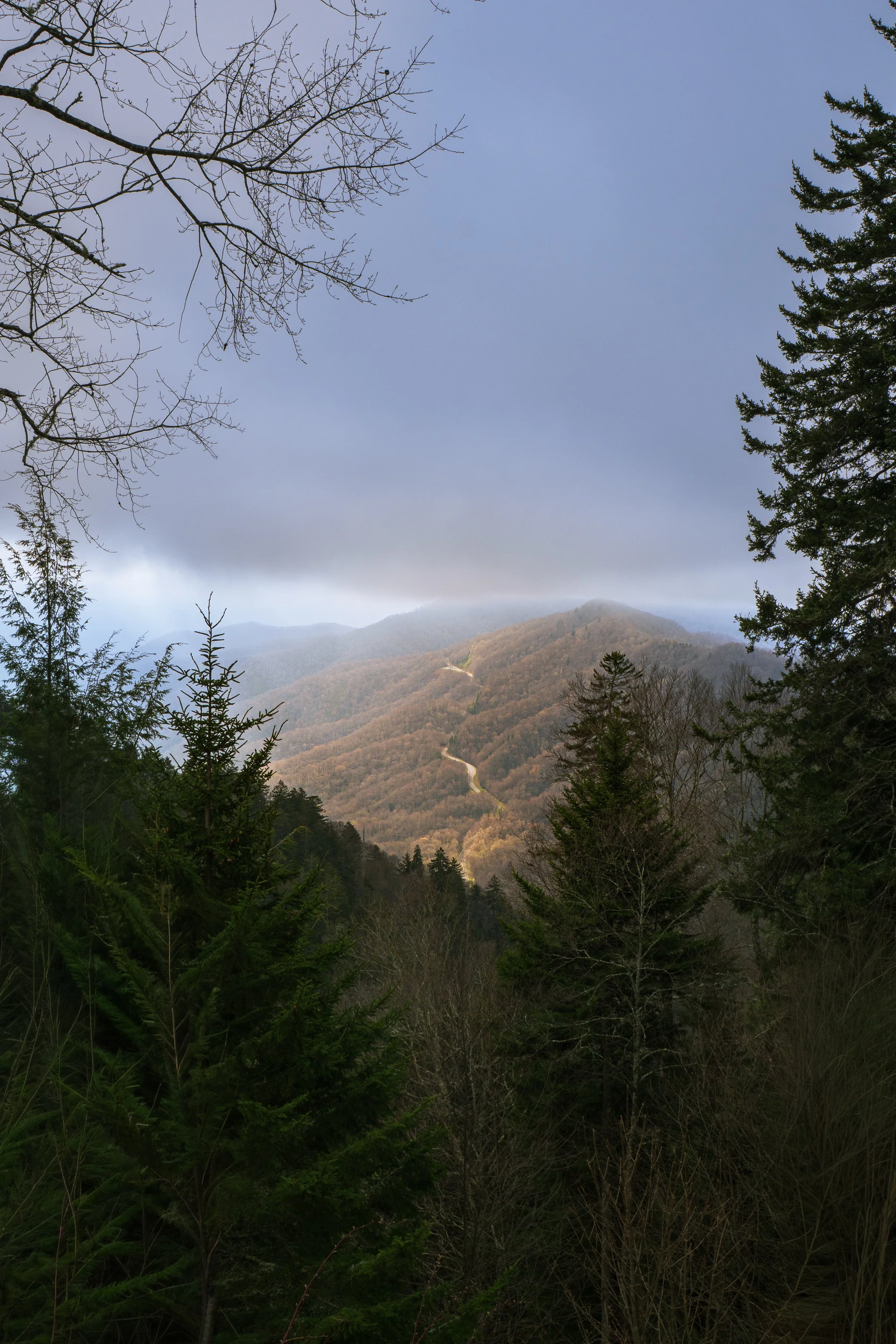
Temperatures dropped dramatically with elevation. Eighty degrees became fifty-five in a matter of miles. The Tennessee side descended through incredible sweeping views before eventually leading toward one of the most famous motorcycle roads in the world:
The Tail of the Dragon.
318 curves in 11 miles.
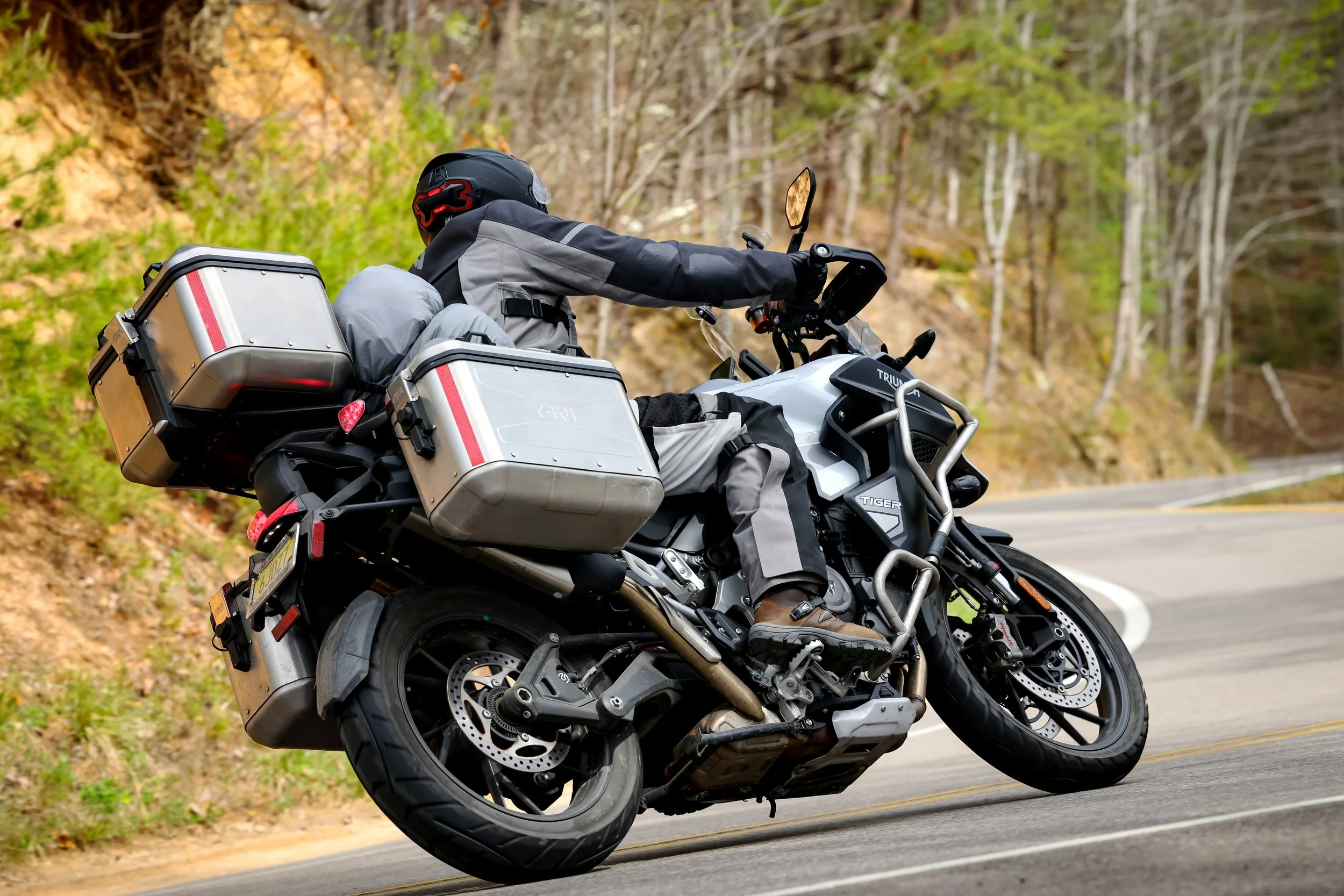
The road itself was exhilarating. Perfect pavement. Endless switchbacks. Banked turns that seemed designed specifically to tempt overconfidence.
Then I reached the bottom and discovered the “Tree of Shame,” decorated with broken motorcycle parts from crashed riders.
In hindsight, I was glad I saw it afterward and not beforehand.
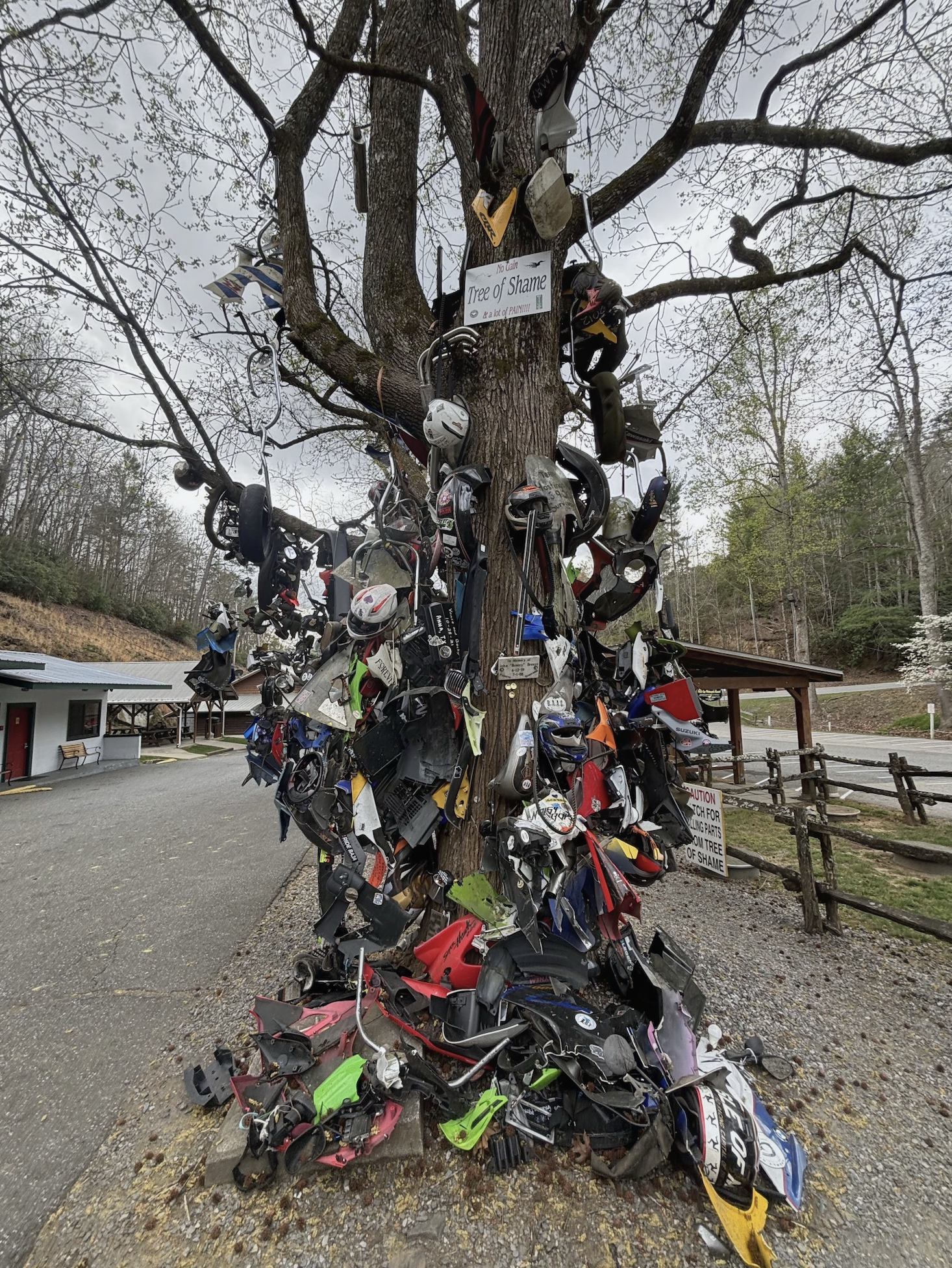
When the rain arrived, it came hard. Cold highway rain at speed feels less like weather and more like being sandblasted by nature itself.
I had planned to sleep at a dispersed campsite in Cherokee National Forest overlooking a lake, but as I got there I found the area was inaccessible due to road closures. I sighed as massive storm clouds loomed overhead and thunder echoed through the mountains.
Once again, plans collapsed.
Once again, the trip became better because of it.
I drove around trying to find a signal so I could research a place to stay overnight.
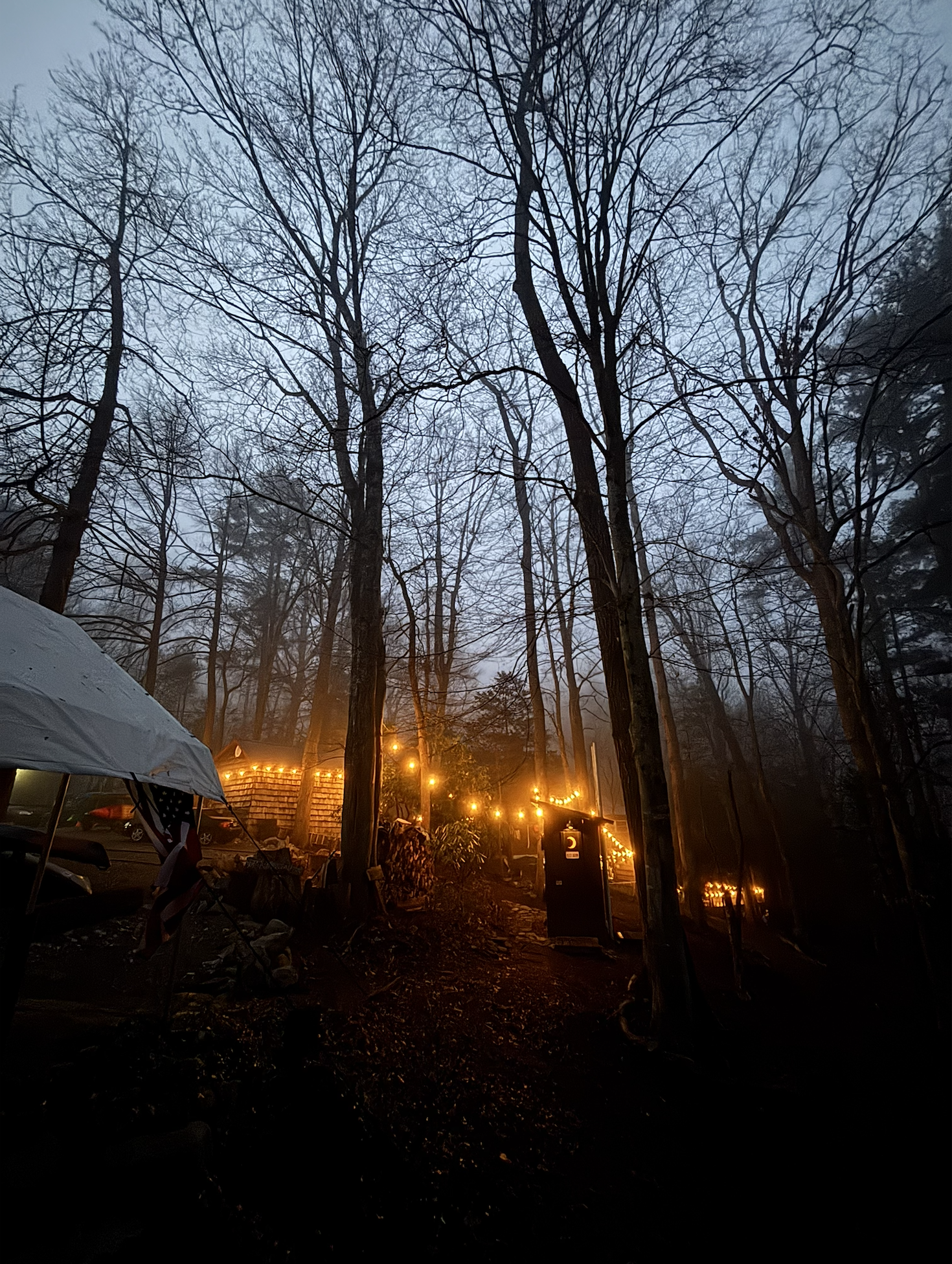
Eventually I found an Appalachian Trail hiker hostel called Boots Off Hostel & Campground run by a woman whose trail name was Lucky Moon. Helping me find shelter from this storm, she was my lucky moon indeed.
The place was wonderfully weird.
Hikers drifted around in various stages of exhaustion and enlightenment. Gear hung everywhere. Muddy boots lined porches. Conversations bounced between trail miles, weather forecasts, and whatever temporary philosophy emerges after weeks spent walking through mountains.
It immediately felt familiar. Like stumbling into a parallel version of my own tribe.
Backpackers and long-distance riders are not actually that different. Both groups willingly abandon comfort in pursuit of movement. Both carry their lives in bags. Both become slightly feral after enough time outdoors.
Lucky Moon showed me to a glamping tent while thunder rolled across the mountains.
Nothing on the trip had gone according to plan. And honestly, I was having a blast.
Day 6 & 7: Home
Looking for a faster ride back north than meandering through the mountains, I hit the wide tarmac of the interstate highways. The final days blurred together as much as the passing exit signs.
The sun crossed from one side of the highway to the other, strangers struck up conversations at gas stations, telling tales of old.
It’s funny. As a guy in my 20s when I first got into riding, I had the thought, “Chicks, dig motorcycles. This is going to strike up so many flirtatious conversations.” While I suppose that’s still true, 99% of those conversations are old men approaching you saying, “You know, I used to have one of those.” As they stare off into the distant dispersed clouds as if they were their own fading memories.
Not long until I take on that role at gas stations, I suppose.
Along the way, I had my first experience inside a famous or infamous ‘Buc-ee’s’, The super Walmart of rest stops. It felt less like a gas station and more like witnessing the collapse of civilization inside an auctioneer house dedicated entirely to brisket and consumerism.
Eventually I reached Virginia and stayed with my old high school friend Baker, a fellow military vet-turned history teacher. We sat on his porch drinking beer and smoking cigars while swapping stories the way veterans always do: somewhere between comedy and therapy.
Then came the long ride home.
A week of cold mornings, closed roads, dirt tracks, cheap motels, mountain sunsets, gas station coffee, and controlled chaos. 1,717 miles and 35 hours in the saddle, total
When I finally pulled into the driveway, Ariana was waiting outside on the lawn, watching my location tracker like mission control welcoming home the Artemis crew.
And somewhere during that long ride north through Appalachia, I realized that geography matters less than the willingness to step into the unknown.
And I suspect motocamping will become a permanent extension of that search for adventure me.
Not a replacement for backpacking.
Just another way to disappear into the world for a little while.